Sunday, April 17, 2016

The Heavenly Soup of Our Lady

JMJT! Praise be Jesus Christ! Now and Forever!


The Soup, Pablo Picasso 1902

I ran across this picture when looking for images that might represent a moment that has etched itself upon my mind while studying and reading Mariam - The Little Arab by Amedee Brunot in our formation class. The story read like a novel. After refusing to convert to Islam at the suggestion of a protector and fellow servant, the Little Arab, as she is fondly referred to, was taken her to a dark alley and her throat was slit open as she lay there being left for dead. This occurred on the September 8th, 1858, which is the Feast day of Our Lady's Nativity. She recounted to her Novice Mistress as follows,  

“A nun dressed in blue picked me up and stitched my throat wound. This happened in a grotto somewhere. I then found myself in heaven with the Blessed Virgin, the angels and the saints. They treated me with great kindness. In their company were my parents. I saw the brilliant throne of the Most Holy Trinity and Jesus Christ in His humanity. There was no sun, no lamp, but everything was bright with light. Someone spoke to me. They said that I was a virgin, but that my book was not finished. "


She then found herself once again in the grotto with this beautiful  lady in blue.  One day, the unknown nurse prepared some soup for her that was so heavenly and delicious that she asked for more. She would never forget the taste of this heavenly soup, but was promised that on her death bed she will taste it again. She reminisced, "She made me some soup! Oh, such good soup! There I was a long time, looking, and never ate soup like that. I have the taste in my mouth. She promised me that at my last hour, she will give me a little spoonful of it."  

How much do we all yearn for this soup? The comfort of our mother's tender love and care when we are sick, when we have fallen low in life, or we are in emotional or physical need or pain? We all seek and pine for the tenderness of mothers in our lives, and we look even further to our Celestial Mother and Queen who can provide perfect maternal love and concern for her children. If we really meditate on this heavenly soup, I think that we can all recall times when God delivered a healing remedy to our woes, that was delivered by the Theotokos, the Mother of God, Spouse of the Holy Spirit.  Job was promised in his darkest time of need, ""God is leading you away from danger, Job, to a place free from distress. He is setting your table with the best food. [Job 36: 16] How many times has she interceded for us and kept us safe from harm! 

During this Easter season, we must continue to explore the vast expanses of how Our Lord has provided 'heavenly soup' for our souls when we have needed it most. We should keep close to our hearts song of praise and thanksgiving, that even in the most difficult of circumstances, we are not left orphans, but instead Our Triune God sends us relief in the form of graces and packages both big and little that warm our hearts and give us hope. These are given to us by a variety of people in our lives, but most especially through the hands of Our Lady who loves all of her spiritual children throughout the world.  


Sunday, March 13, 2016

Lenten Musings on Silence & Prayer Père Jacques Style

JMJT! Praise be Jesus Christ! Now and Forever!


The Lenten liturgical season is marching rapidly towards Holy Week, and I have been silent. Although my life continues to swirl with activity and a balancing act between prayer, tending to my family, and work, it probably wouldn't look silent from bystanders on the outside. But, amidst this I've had the opportunity to read and study a beautiful book that calls us to reflect on the role of silence and prayer in our lives. It is called Listen to the Silence, by Père Jacques de Jésus , and consists of notes taken from 14 conferences he gave to the nuns at the Carmel of Pontoise in September, 1943, just prior to his arrest by the Nazis for harboring Jewish students at his all boys school where he was Headmaster.  [For more information on his life, go to perejacques.org]  

In this retreat, Père Jacques gets to the heart of the matter and drills deeply into what it means to be called to prayer and to live the evangelical counsels in our daily lives. He reveals the very purpose of Carmel as 'a community of human beings who reveal God to other human beings.' He further insists that, 'There should be a Carmel in every city, and then there would be no need for works. One would see God through these human beings who live for him and Him alone.'  Wow! That is quite a statement about the strength of love and prayer found in the School of Carmel if we truly live it. 

This is where the challenges begin.  Some of his maxims and questions can be excellent tools for meditation and an examination of conscience for us during this season that calls us to personal growth and stretching out of our comfort zones. I'll share a few such nuggets of wisdom here.

1. "We cannot see Christ and remain as we are. To see Christ, we must do as Zacchaeus did. We must become poor. Riches drag down the soul. One has to become small in stature, that is detached from the goods of the world."

2.When I speak of seeing Christ, I mean the mysterious, misty vision of faith, which is the fruit of the prayer of simple regard and not the result of any activity on our part. I mean the experience of being swept up by Christ himself. When we have diligently devoted  ourselves to charity, obedience, service, and self-control, and when Christ has seen the constancy of our commitment, then he Himself comes to us."

3.  "Prayer should be our steady, supernatural method of breathing, day and night, in the silence of our souls."

4. Père Jacques speaks of those who want only consolations in prayer, and eventually walk away from God. Then he asks, "In truth, are we any different? Are we not likewise lacking in courage and total acceptance? Do we not seek to exercise choice, to impose conditions, and to  make bargains in our relationship with God?" What about adopting the attitude of st. Therese: 'Lord, I accept all.'?

5. He addressed to religious, but this can also apply to all Carmelites and those following Jesus, "In response to the question: What is our life's work, we have said: to be persons of prayer. If we are not persons of prayer, our lives are meaningless. Even God can do nothing with us, if we are not persons of prayer."  

6. "We live our lives only once, not twice. Therefore, each day, which slips slowly through our fingers, hour by hour, is irretrievable. A life misspent is lost forever."

7. "We must die to ourselves. Our 'I' must come to know this mystical death in order to know the fullness of prayer.  If we hold onto ourselves for fear of mystical death and the surrender of our worldly desires ,and if we hold on to our soul with its earthly attitudes, then we will remain just as we are with our own little soul and our own little bit of human happiness.  We must let our human 'I' diminish and ultimately coalesce into the divine will, the very being of God."


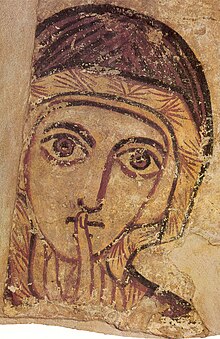
Coptic, 8th century, National Museum in Warsaw

8. "God is eternal silence; God dwells in silence....The works of God are marked in silence...Silence is the great master. It speaks to the human heart. Silence is not a empty void; God dwells therein." 

9. Regarding our own interior silence, "The soul must not be a public square, where there is always a crowd of gossipers or of persons recalled from the past with their tales of suffering and rebuke. Such types, seething at their imagined foes and smarting in their own self-love, are seriously at fault."

10. Père Jacques spoke of baptizing our suffering. "At no moment did Christ conceal any element of his Passion from his Mother.  Christ treated all the saints, without exception, in the same way. To the measure that He loved a soul, to that degree he saddled it with trials. What else would you expect? Christ is not someplace other than on the  Cross, with his head torn open by the crown of thorns and his body pierced by the whips and nails of his executioners...When Christ embraces someone, that person's head is touched by the crown of Thorns on the Lord's head  and the mark of the cross is left on him, because the Lord's mangled hand is covered with blood. To espouse Christ is to espouse the Cross."

Words of Hope and Comic Relief

These counsels might seem burdensome or make one feel like a beginner, as it were. The easiest means of dealing with our shortcomings and this call to do better is to emulate St. Terese's littleness, and remember her quip after falling and arising again with Christ at her side, 'And so we begin again.'  Père Jacques advises us to also remember our Holy Mother, St. Teresa of Avila who accepted all of God's Will in abandonment. She would confidently proclaim, "God is all powerful and He loves me." This slays our fears and our egos. It allows us to approach Our Lord as His children, and follow Him unreservedly.

I will leave you with this humorous story. A couple of weekends ago, my family attended a Christian music festival in the evening. We did not get tickets to this sold out show at Grand Canyon University, but they were inviting everyone to come and watch for free on huge screens that they had set up for the event. And so we went with lawn chairs in hand. The first band was a bit quirky to say the least. One song was about a chainsaw and featured the musicians hacking away at an imaginary tree with a chainsaw. My daughter looked at me perplexed and said, 'What next? A weed wacker?' As odd as it was, I kept thinking about that image and sawing away my sins - cutting them out of my life, and preferably at the roots. Of course, some things we can actively do on our own to stop our sins and bad habits, and other deeper issues need passive purification and healing. I then thought of the kinder, gentler  image I associate with St. John of the Cross. A pair of scissors to cut the little strings that hold us back from our souls ascending to God in prayer. 

I am still in need of the scissors, and still in need of God's Grace and Mercy which allow this cutting out and ridding the fungus in our lives.  In all of this, I know that silence is the key to knowing ourselves, knowing God, recognizing where we need healing and forgiveness, and moving forward with the Holy Spirit at our sides. Père Jacques reminds us of this in a beautiful way.


Sunday, February 7, 2016

Jessica Powers Celebrates Divine Mercy


JMJT! Praise be Jesus Christ! Now and Forever!


Today is the birthday of Jessica Powers, the great Carmelite mystic otherwise known as Sister Miriam of the Holy Spirit who lived and died in the 20th Century in America. Sister Miriam was a creative soul who was seeking God from an early age. She loved Our Lord and she loved all of His creation, where she found His fingerprints especially pronounced and constantly whispering and revealing His Divine Wisdom to her. She was able to express this love in prayer, silence, and her beautiful poetry that touched people's lives even before being called to consecrated religious life. Upon examination, her entire life was one of seeking all in the All, and constantly questioning the meaning of life in a pure existential spirit. As so often happens, the more she probed and prayed in open receptivity to the movement of the Holy Trinity, the more questions were stirred, but also contributed to an increase in faith and peace.  

Just a bit of background on the poet mystic- She was a native of Wisconsin, born in 1905 near Mauston. Following the death of her parents, she returned home to care for her siblings and the family farm after two one-year journeys. The first took her to Marquette University in Milwaukee as a student, the second to a job in Chicago. When her brothers and sisters were old enough to care for themselves, Jessica moved to New York in 1937 to pursue a career in writing. Her poems were published in a variety of magazines including Commonweal and America. Her first collected work of poems was published in book form in 1939.


In 1941 she entered the Carmelite community in Milwaukee, which moved a few years later to Pewaukee, Wisconsin. She became Sister Miriam of the Holy Spirit and eventually the superior of the community. She continued to write poetry, which was collected into several volumes, including a book of poetry for children. Jessica Powers died at the Carmelite monastery in August 1988. [See http://www.churchsp.org/mercyofgod]
Through her life experiences and her observations of nature and changing seasons, she understood the pattern of the Savior that repeats itself in all of humanity and His creation. Namely, she saw the kaleidoscope of birth, life, death and resurrection in every soul around her, most notably her own. She further understood the role of Divine Mercy as the core healing balm of every one of these experiences, and as a catalyst to cope with and embrace new seasons in one's life and to finally enjoy divine intimacy with God. Two poems come to mind that explore this mystical reality: The Garments of God and The Mercy of God. 
The Mercy of God 
I am copying down in a book from my heart's archive
the day that I ceased to fear God with a shadowy fear.
Would you name it the day that I measured my column of virtue
and sighted through windows of merit a crown that was near?
Ah, no, it was rather the day I began to see truly
That I came forth from nothing and ever toward nothingness tend,
that the works of my hands are a foolishness wrought in the presence
of the worthiest king in a kingdom that never shall end.
I rose up from the acres of self that I tended with passion
and defended with flurries of pride:
I walked out of myself and went into the woods of God's mercy,
and here I abide. 
There is greenness and calmness and coolness, a soft leafy covering
from judgment of sun overhead,and the hush of His peace, and the moss of His mercy to tread.I have nought but my will seeking God; even love burning in me is a fragment of infinite loving and never my own.
And I Fear God no more; I go forward to wander forever
 in a wilderness of His infinite mercy alone.
Within this ode to God's Mercy, one recognizes the call of nada...the perpetual Fall-like nakedness of the soul that calls one to continually shed layers of crud, untruth, and false selves, in order to allow the expansion of the soul for The Holy Trinity to dwell within. 
The Art Room: Bare Trees: Vincent van Gogh: Ink Drawing, Gogh Drawings, Gogh Sketches Drawings, Art Van Gogh, Van Gogh Museum, Winter Garden, Gogh 1853 1890, Vincent Van Gogh
The Art Room, Bare Trees By Vincent Van Gogh
Selected Poetry of Jessica Powers, edited by Regina Siegfried and Robert Morneau, presents the above poem, as well as the Garments of God.
Garments of God
God sits on a chair of darkness in my soul.
He is God alone, supreme in His majesty.
I sit at His feet, a child in the dark beside Him;
my joy is aware of His glance and my sorrow is tempted
to nest on the thought that His face is turned from me.
He is clothed in the robes of His mercy, voluminous garments—
not velvet or silk and affable to the touch,
but fabric strong for a frantic hand to clutch,
and I hold to it fast with the fingers of my will.
Here is my cry of faith, my deep avowal
to the Divinity that I am dust.
Here is the loud profession of my trust.
I need not go abroad
to the hills of speech or the hinterlands of music
for a crier to walk in my soul where all is still.
I have this potent prayer through good or ill”
here in the dark I clutch the garments of God.

The Return of the Prodigal Son(1773) by Pompeo Batoni

In this Jubilee Year of Mercy, Sr. Miriam's poetry captures the innate mercy of God within the cycles of life which grips the soul, and opens up possibilities for anyone, including those who sometimes get lost on the journey of life...even the most hardened of sinners. At the deepest center of its meaning is hope. Hope in new beginnings, in reclaiming who we are, and realizing and becoming a new creation, and the person that God created each of us individually to be in His Kingdom.   There is not a single person living who does not need this mercy, to taste it, to know it, and to believe in it. There is not a person who does not need a new beginning in some dark recess of his or her heart and soul.  That is the beauty of this year, and her timeless message. 


Thursday, January 21, 2016

Canticle to St. Agnes written by St. Thérèse of Lisieux

JMJT! Praise be Jesus Christ! Now and Forever!


St. Thérèse of Lisieux was enamored by the strength and fervor of several female martyrs including St. Agnes, St. Joan of Arc, and St. Cecilia. She so loved St. Agnes that it was said that while on pilgrimage in Rome, she took a red mosaic stone from St. Agnes' burial place in the Catacombs, by climbing down an opening where the ruins lay!  She called this early saint, 'a childhood friend' [Story of a Soul]. She even wrote to her beloved sister Pauline, who became known as Mother Agnes of Jesus, shortly before entering Carmel in 1887, "Thérèse, the little Spouse of Jesus, loves Him for Himself; she only looks on the Face of her Beloved to catch a glimpse of  the Tears which delight her with their secret charm...At all cost I must win the palm of St. Agnes; if it cannot be mine through blood, I must win it by Love." [See www.pathsoflove.com/pdf/ThereseLetters.pdf]

St. Agnes' feast day is today! She was a young Roman girl who promised her life to God. Because of her beauty many men wanted to marry her, but she always refused, saying "Jesus Christ is my only Spouse." One of them became so angry when she refused him, he turned her in for being a Christian. She was then tortured and killed for refusing to deny her faith. She was only thirteen years old when she was martyred. She is the patron of young girls, and is often pictured holding a lamb, as her name is very similar to the Latin word "Agnus" which means lamb.
Below, is a beautiful song that St. Therese composed to honor this special Feast Day of Virgin and Martyr St. Agnes.

                                                       CANTICLE OF ST. AGNES.
"My only Love is Christ."
From the Acts of her Martyrdom
Christ is my Love alone, all life is He for me;
He is my one Betrothed, Who charms my dazzled eyes;
E'en now I hear vibrate the solemn harmony
Of His melodious sighs.
With precious stones and gold He decks my flowing hair,
Already on my hand shines bright His nuptial ring;
And many lustrous stars, magnificently fair,
Are love gifts from my King.
With pearls, all price beyond, has He adorned my hands;
About my neck He placed a necklace wondrous bright;
Celestial rubies red, from far off unknown lands,
Bedeck my ears tonight.
Betrothed am I to Him on Whom the angels wait,
Trembling before His throne throughout eternity;
The sun and moon His praise with rapture will relate,
Till time shall cease to be.
Divine His Person is; heaven is His realm of bliss;
He for His Mother chose a Virgin here on earth;
Who no beginning hath, nor end, His Father is,
Eternal is that birth.
Ah! when this Jesus Christ at times to touch I dare,
More pure becomes my heart; more chaste, dear Lord, am I!
The kisses of His mouth give me the treasure fair
Of blest virginity.
His signet He hath set already on my face,
That so no earthly love may dare draw nigh to me;
Kept thus for Christ alone, by His abiding grace,
Cleansed by the precious Blood He shed on Calvary's cross,
Already here I taste of heaven's matchless bliss;
The honey and the milk with joys that know not loss
Come to me with His kiss.
No thought of fear have I, of either flame or sword:
For naught can now disturb this perfect heavenly peace
A fire of love divine pervades my soul, O Lord:
And never shall it cease.
                                                                      January 21, 1896

Sunday, January 3, 2016

St. Basil's Wisdom & Purported Carmelite Connections


JMJT! Praise be Jesus Christ! Now and Forever!


Two summers ago, I was blessed enough to visit Turkey for three weeks. I was enchanted by the beauty of this ancient crossroads between East and West, and its beautiful landscape, architecture, history, and culture. When visiting Cappadocia, I was further mesmerized by the churches hewn out of rocks located within a series of cave structures, where the early Christians escaping from oppression, and persecutions between 4th and 13th centuries worshiped and lived in community. St. Basil was the bishop of Kayseri at that time who taught and influenced his flock, and the Church beyond. He created a rule of life, now known as the Rule of St. Basil that guided those living in his monasteries in this region of Turkey.  A chapel was even built in his name which can now be seen and explored in the Goreme Open Air Museum.   


Why do I mention St. Basil 24 hours following his Feast Day [and that of St. Gregory of Nazianzus] whom he shares this day with? Namely, because many early Carmelites believed that the original rule of the Carmelite Order was taken from the Rule of St. Basil, before being adopted and tweaked by St. Albert. In addition, many insist that St. Basil lived on Mt. Carmel and was among the early Carmelites who prayed in the spirit of Elijah. 'pondering the law of the Lord day and night', and who greatly honored Our Lady.   


Ordained a bishop in 370, he enabled the reform of priests and other religious, insisting on a commitment to orthodoxy and a strong religious discipline among the clergy. He was responsible for the promulgation of the Nicene Creed to the faithful and the defeat of Arianism at the Council of Constantinople. He also practiced great acts of mercy and charity including work with the poor, sick, hungry, and homeless.
Perhaps one of the most important documents we can study by St. Basil the Great is "On the Holy Spirit", which gives us a road map in our spiritual life and can help us especially as we kick off the new year and continue to seek to live the call to practice mercy ever more deeply in this Jubilee year. He wisely proclaimed, 
The titles given to the Holy Spirit must surely stir the soul of anyone who hears them, and make him realise that they speak of nothing less than the supreme Being. Is he not called the Spirit of God, the Spirit of truth who proceeds from the Father, the steadfast Spirit, the guiding Spirit? But his principal and most personal title is the Holy Spirit.

To the Spirit all creatures turn in their need for sanctification; all living things seek him according to their ability. His breath empowers each to achieve its own natural end.

The Spirit is the source of holiness, a spiritual light, and he offers his own light to every mind to help it in its search for truth. By nature the Spirit is beyond the reach of our mind, but we can know him by his goodness. The power of the Spirit fills the whole universe, but he gives himself only to those who are worthy, acting in each according to the measure of his faith.

Simple in himself, the Spirit is manifold in his mighty works. The whole of his being is present to each individual; the whole of his being is present everywhere. Though shared in by many, he remains unchanged; his self giving is no loss to himself. Like the sunshine, which permeates all the atmosphere, spreading over land and sea, and yet is enjoyed by each person as though it were for him alone, so the Spirit pours forth his grace in full measure, sufficient for all, and yet is present as though exclusively to everyone who can receive him. To all creatures that share in him he gives a delight limited only by their own nature, not by his ability to give.

The Spirit raises our hearts to heaven, guides the steps of the weak, and brings to perfection those who are making progress. He enlightens those who have been cleansed from every stain of sin and makes them spiritual by communion with himself.

As clear, transparent substances become very bright when sunlight falls on them and shine with a new radiance, so also souls in whom the Spirit, become spiritual themselves and a source of grace for others.

From the Spirit comes foreknowledge of the future, understanding of the mysteries of faith, insight into the hidden meaning of Scripture, and other special gifts. Through the Spirit we become citizens of heaven, we enter into eternal happiness, and abide in God. Through the Spirit we acquire a likeness to God; indeed, we attain what is beyond our most sublime aspirations - we become God.

Let us stay close to the Holy Spirit to discern what God's Will is in this new year, and then to have the strength and courage to give our fiat and do it! St. Basil the Great, pray for us! Amen.


 Image result for St. Basil in Cappadocia

Friday, January 1, 2016

Celebrating Theotokos in the Year of Mercy


JMJT! Praise be Jesus Christ! Now and Forever!


Happy New Year & Feast of Mary, Mother of God! It is always such a joy to begin the year celebrating the maternity of Our Lady, as mother of Our Lord Jesus, as well as of all of her other billions of spiritual children on earth, including each of us and our loved ones! 

This Jubilee Year of Mercy gives me pause, as it not only challenges me to practice the spiritual and corporal works of mercy more fully and fervently towards my family and neighbor, but it invites me to enter into Our Lady's School of Virtue to contemplate in my heart, the true meaning of mercy.  

When doing some research for a presentation I was doing on Mary, Mother of Mercy, I was struck by the meaning of mercy in Hebrew. In this ancient language Rachamim means ‘mercy’. This is the plural form of the word racham which means ‘womb’. The notion of mercy most closely bespeaks of a mother's tenderness for her infant. Jesus is the fruit of two wombs, the one in eternity from the divine Father: I have begotten you from the womb before the morning (Ps 109 (110):3), the other in time from a human mother: ... you will conceive in [the] womb and bear a son (Lk 1:31). 

In his Person He is The Divine Mercy in the Flesh.  Mary's pure womb was the true Mercy Seat that shared the Suffering Servant's sacrifice foretold at His first offering in the Temple:"And a sword will pierce your own soul too" (Lk 2:35).  [See thedivinemercy.org] The blood and water which filled her womb in protection of the Messiah in utero, would foreshadow the blood and water which was poured out for all of mankind in his last act of Divine Mercy.


St. Louis de Montfort explains that, "It was in this mystery that Jesus, in the womb of Mary and with her co- operation, chose all the elect. For this reason the saints called her womb, the throne-room of God's mysteries." 

Throughout his potificate, Saint Pope John Paul II embraced de Montfort's spirituality and recognized Our Lady's role in joining Divine Mercy with her maternity of God and of her children. He explained that Our Lady’s Magnificat rejoices that God, ‘has mercy on those who fear him, from generation to generation.’ We too share in this mercy and she is Our Mother of Mercy [Dives in Misericordia]  He also shares with the faithful that, “Mary is the Mother of Mercy because her Son, Jesus Christ, was sent by the Father as a revelation of God’s mercy.’ She is also Mother of Mercy because it is to her that Jesus entrusts the Church & all humanity” [Veritatis Splendor]

I leave you with the words of our present Pope Francis, who declared this Jubilee Year of Mercy. He wrote in his Bull entitled, Misericordiae Vultus, as follows:

“My thoughts now turn to the Mother of Mercy. May the sweetness of her countenance watch over us in this Holy Year, so that all of us may rediscover the joy of God’s tenderness. No one has penetrated the profound mystery of the incarnation like Mary. Her entire life was patterned after the presence of mercy made flesh. The Mother of the Crucified and Risen One has entered the sanctuary of divine mercy because she participated intimately in the mystery of His love.

     
Chosen to be the Mother of the Son of God, Mary, from the outset, was prepared by the love of God to be the Ark of the Covenant between God and man. She treasured divine mercy in her heart in perfect harmony with her Son Jesus. Her hymn of praise, sung at the threshold of the home of Elizabeth, was dedicated to the mercy of God which extends from “generation to generation” (Lk 1:50). We too were included in those prophetic words of the Virgin Mary. This will be a source of comfort and strength to us as we cross the threshold of the Holy Year to experience the fruits of divine mercy. Mary attests that the mercy of the Son of God knows no bounds and extends to everyone, without exception.” [Pope Francis]
 
Let us treasure all of these things in our heart in a special way this year, and then live them in order to fulfill the opportunity of this special year of mercy for all. Amen. 

Saturday, September 12, 2015

Feast of the Most Holy Name of Mary

JMJT! Praise be Jesus Christ! Now and Forever!


September 12:  Most Holy Name of Mary


Eight days after the birth of the Blessed Virgin, her holy parents, Saint Joachim and Saint Anne, inspired by God, gave her the name of Mary. The name Mary means Lady, and also Star of the Sea. Just to say her holy name is a prayer. It gives everyone who does so favor with God and power over the devil.
Blessed Pope Innocent XI set up the feast of the Holy Name of Mary in 1683 to thank her for the victory which the Catholic army under John Sobieski, King of Poland gained over the Turks (Mohammedans), who were trying to sack Vienna and move in and conquer all the Catholics of the West. Mary’s name occurs in the first part and in the second part of the Hail Mary. In the middle of the Hail Mary, one speaks the Holy Name of Jesus.

Great apostles of the Holy Name of Mary have been Saint Anthony of Padua and Saint Bernard of Clairvaux. Saint Bernard of Clairvaux says, “O most holy Virgin Mary, your name is so sweet and admirable that one cannot say it without becoming inflamed with love toward God and toward you.” Others of particular note are St. Louis Marie de Montfort, St. Alphonsus Liguori and St. Maximilian Kolbe. The Holy Father, Bl. John Paul II, choose as his motto Totus Tuus which is to say, “I am all yours (Mary).”
- See more at: http://airmaria.com/2011/09/12/thoughts-on-the-holy-name-of-mary/#sthash.5oD6x0jz.dpuf


Let us call on Our Lady to stamp out any evil or temptation that assails us, and give our souls refreshment. We must not hesitate! Inspired by this reality, I wrote some time ago to Our Lady,

You are like aloe on burnt skin;
Fresh spring water upon parched lips;
Honey to sweeten any bitterness..

Indeed. So many saints acclaimed her name as a maternal refuge. St. Therese penned as such in her last poem entitled, Why I love thee of Mary'

 Fain would I sing, O Mother blest! the reasons why I love thee; 
 Why e’en to name thy name, with joy, O Mary! fills my heart; 
And why the glorious thoughts of thee, in greatness far above me, inspire no fear within my soul, so dear and sweet thou art. 
Yet, if I were to see thee now, in majesty stupendous, 
Surpassing all the crowned saints in highest heaven above, 
Scarce could I dream I am thy child, (O truth sublime tremendous!), 
 For I should think myself to be unworthy of thy love. 
 The mother, who desires to be her child’s best earthly treasure, 
Must ever share its grief with it, must understand its pain.