Wednesday, July 10, 2013

Three Carmelite saints named as Patrons and Intercessors for World Youth Day- 2013 in Brazil

JMJT! Praise be Jesus Christ! Now and Forever!

We know how precious children and young people are to Our Lord, as we are commanded by Jesus to become like them. We also know how the youth and their innocence is being attacked on all sides. As World Youth Day approaches, let us especially pray to the following three holy exemplars who have been chosen from our order for these momentous event to help strengthen our children and bring them closer to Our Lord as they "Go and make disciples of all nations" (Mt 28: 19).

The three are as follows:


Blessed Isidore Bakanja

Martyr of the scapular!

Biography
Isidore was born approximately in 1890, in Bokendela, Congo. He has had a very poor life and he worked as a farmer in the field. His baptism in 1986, was from his meeting with Carmelite missionaries who gave him a Rosary and the scapular of Our Lady of Carmelo. Very devoted of the Virgin Mary, he merrily prayed and sang while working. Once, unable to do so, he decides to leave his post, but without accepting the order to leave the visible signs of his faith. He was wounded on his back with whips and died, because he didn't resist to the wounds. We invoke him as a martyr of the scapular.
Prayer
That with the example of your faith we will be strengthened against the adversities of life and be protected by Mary, our Mother. Amen.


Saint Therese of Lisieux

Patroness of the Missions!

Biography
St Therese of Jesus was born in France in 1873. At 15 she went into a Carmelite monastery, where she lived with humility and simplicity her total trust in God. She was proclaimed Patroness of the Missions in 1927, by her deep desire to be a missionay and by her willingness to give everything for the good of others. The WDY invokes her as the Missions Patroness!
Prayer
Grant me your missionary spirit to bring Jesus to all the villages! Amen.


Saint Teresa of the Andes

Contemplative Christ!

Biography
Born in Chile in 1900. Since the age of 6 she participated almost daily at the Holy Mass. Her constancy in the Eucharist reveals her inner thirst to meet Christ. Many people say that before entering to the Carmel, at 17, she lived a holy life, which attracted souls to God. She was always aware that her prayer and sacrifice were able to improve and purify the world. Currently on her tomb we see her words: "Love is stronger." We pray for her intercession for us to learn to be contemplatives of Christ!
                                                                                       
Prayer
May I find in my soul, with your intercession, the desire to worship and glorify Jesus without pause. Amen!                        


Bless                              


Bles


Sunday, June 30, 2013

Spanish Colonial Art honors our Carmelite saints

File:San Miguel Mission Santa Fe Altar.JPG


JMJT! Praise be Jesus Christ! Now and Forever!

I just returned from a trip to New Mexico, where my husband and I spent time in both Albuquerque and in Santa Fe. I was struck by the rich heritage of Native American, Spanish, and Mexican cultures when one visits there. In particular, Santa Fe boasts the oldest mission in the United States at St. Miguel, and a vibrant art community that thrives on creating art in the style of Spanish Colonial style. The altar piece shown above is found in this mission, and depicts St. Teresa of Avila in the upper left-hand corner. This art celebrates the Catholic Church, Our Lord, Our Lady and Her saints.  It recognizes that everyday human life is intrinsically interwoven with God's Will, love, and plans for each of us.  It abounds with images of Our Lady and beloved saints which were painted on tables, mirrors, other various furniture, altar pieces, tabernacles, as well as found in framed pictures. 

I was struck by several pieces which featured our Foundress, St. Teresa of Avila.  According to Paul Rhetts, the co-publisher of Tradición Revista and an expert in Spanish Colonial Art, "Santa Teresa de Jesús (or de Ávila) is not a frequent image in the historic santos of New Mexico (from 1700-1900). According to ongoing research on the frequency and iconography of images by the author and funded by the Kriete Family Foundation, although Teresa appeared infrequently in the santos of New Mexico, she had a rather high degree of importance, evidenced by the fact that she may appear on five different altarscreens in New Mexico; only two other females appear more often on altarscreens — Santa Bárbara (12 times) and Santa Gertrudis (6 times). Santa Rosalía also appears five times on altarscreens in New Mexico. Teresa is the sixth most frequently found female saint (not including the Virgin Mary) in New Mexico. She makes up almost 5% of all the female images (not including the Virgin Mary) in New Mexico.

Some of the most important images of Teresa in the New World are:
Cristóbal de Villalpando, 17th century, Iglesia de San Felipe Neri, La Profesa, Mexico City, Mexico
Baltasar de Echave y Rioja, attributed, 17th century, Metropolitan Cathedral, Mexico City, Mexico
Juan Correa, late-17th/early-18th century, Churubusco, Museo Naciónal de las Intervenciones, Mexico City, Mexico (thought to have been displayed in the high altar of the first convent of Discalced Carmelite nuns founded in Mexico City, called Santa Teresa la Antigua, now defunct)
Juan Correa, 17th century, parish house at San Miguel Nonoalco in Mexico
José Nava, 18th century, Puebla, Mexico

Anonymous, 18th century, Monastery de Carmen Alto, Quito, Eucador
Anonymous, 18th century, Monastery de Santa Teresa, Cuzco, Peru
Anonymous, 18th century, Monastery de San Bernardo, Salta, Argentina

There are fourteen (14) known images of Teresa in New Mexico prior to 1900 by the following santeros: José Rafael Aragon (4), Arroyo Hondo Painter (2), José Aragon (2), Provincial Academic (1), Pedro Antonio Fresquis (1), Laguna Santero (1), and 3 by unknown artists. Five of the images are on altarscreens (Santa Cruz de la Cañada, San Miguel, el Santuario de Chimayó, Córdova, and the Upper Morada at Arroyo Hondo). Of the remaining nine images of Teresa, one is a bulto (by José Rafael Aragon), and eight are retablos.
Iconography
A Spanish Carmelite in the 16th century, she was the leader of the reform of the order and the Counter Reformation. Born in Ávila, she lived from 1515-1582. She was a mystic writer and a Doctor of the Church. She was canonized just 40 years after her death.

She is seen wearing a nun’s garb usually of white and black (originally chestnut or maroon in color as an indication of the discalced order), often with a cloak; holding a crucifix, a crozier with a banner reading “IHS” and having the same emblem on her breast, and sometimes holding a palm. The final stage of her life, between 1555 and 1582, included many mystical experiences including a vision of Christ in his passion from which she advocated a life of retreat and piety.

Occasionally depicted in Spain with a doctoral biretta or mortarboard (she was proclaimed a doctor at the University of Salamanca). In the New World frequently seen with a book and pen. Pilgrim’s staff which ends with a double transverse cross as the founder of the reformed order. A dove, symbol of the Holy Spirit, is often seen above her as an indication of the sublimity of her writings. Sometimes with an angel who wounds her heart with an arrow, sometimes flaming at the tip, a symbol of ecstasy. Enamored with the suffering of Christ, she is said to have proclaimed “either suffer or die” (Aut Pati, Aut Mori) and “I shall sing about the mercies of the Lord forever” (Misericordias Domini in Aeternum Cantabo). She is often associated in the beloved souls in Purgatory, another possible connection with the Penitential Brotherhood.

There are as many as forty-two different scenes used to depict Teresa in the art of the New World — from her conversion and entrance to the Monastery of the Incarnation, through her visit with San Francisco de Borgia and receiving the communion from San Pedro de Alcántara, and to visions of Christ at the Column, the Holy Trinity, San José, Mary, and the Holy Spirit. In New Mexico all the scenes are of Santa Teresa as the mystic writer." (See 
http://nmsantos.com/Resources/Santo-List/Teresa/Teresa.html)

Since art is a means of creating beauty and telling a story, I thought I would share some of the beautiful pieces that I saw there as well as pieces found in other parts of the world where Spanish colonial art is prized. I hope that you enjoy!  


Cuzco School: The Second Conversion of Saint Teresa. ca. 1694. Convento del Carmen
San Jose. Santiago de Chile. Photo: Mebold (1987, 77).


Adriaen Collaert (c.1560-1618) and Cornelis I Galle (1576-1650) designed a series of twenty four engravings on the life of Saint Teresa de Avila (see Gallery 5). This series served as the basis for two series of paintings on the life of the Saint currently in the Convento del Carmen San José (Carmen Alto) in Santiago, Chile. They are known as the Large Series and the Short Series on the Life of Saint Teresa (see Mebold 1987, 54-108).
The series of Collaert and Galle served as the basis of a series of sixteen paintings executed by José Espinoza de los Monteros en 1682 (Mebold 1987, 55). These paintings hang now in the Church of the Carmelite Convent in Cuzco, Peru. They are displayed on the nave of the church, eight per side. The last painting of the series bears the signature shown below (Mesa and Gisbert 1982, 92f).
The Large Series on the Life of Saint Teresa consists of thirteen paintings, each measuring two meters in height by two and a half in width. The Small Series on the life of the Saint consists of twenty paintings, each measuring 1.22 meters of height by 1.63 meters of width. Both series were produced by an unknown member of the Cuzco School of painting. Apparently, he was a follower of José Espinoza de los Monteros, the author of the Cuzco series on the life of Saint Teresa featured in Gallery 5. The Large Series was produced around 1690 and the Small Series around 1694 (see Mebold 1987, loc. cit.). (See http://colonialart.org/galleries/gallery-5-the-life-of-saint-teresa-cuzco-series)

Luis Juarez
Mexico 1585-1636
Saint Teresa of Avila and Her Companions (Fragment) 25.0322
The Spanish mystic, St. Teresa of Ávila (1515-1582), who founded a religious order and who was the first woman to be named Doctor of the Church, was a popular subject in seventeenth-century art. Against her father's wishes, Teresa secretly entered the Carmelite convent in Ávila, Spain as a young woman. In 1652, she succeeded in founding the Convent of St. Joseph in Ávila, the first community of reformed, or Discalced Carmelite nuns (referring to their practice of going barefoot or wearing sandals.) This painting is consistent with the Counter Reformation style in Mexico, in which ecstatic holy figures were portrayed in an intimate, direct way. Holding a bishop's staff in one hand and with her other hand raised as if witnessing a miracle, she gazes lovingly at the prominent flowering tree. The tilt of her head and her pleasant expression make her appear approachable. The meaning of the tree, although assumed to be an allegory for some aspect of her life, or a passage from her writings, has yet to be determined. St. Teresa was an influential author. Among her writings are a spiritual autobiography, The Way to Perfection, advice to nuns, The Interior Castle, a description of the contemplative life, and The Foundations, an account of the origins of the Discalced Carmelites.  [At the Figge Museum in Davenport, IA) See  http://www.figgeartmuseum.org/Collections/Mexican-Colonial.aspx?page=4

Antonio Bisquert
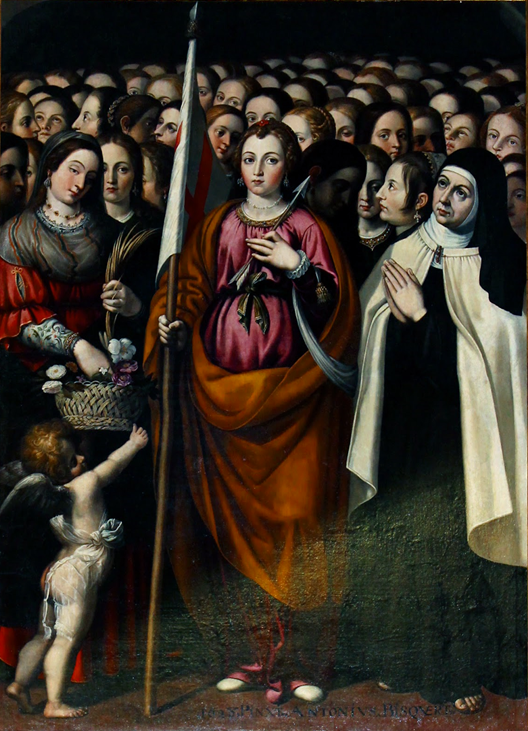
Saint Ursula, Saint Teresa of Ávila, Saint Rosalia, and the Eleven Thousand Virgins (1628)
Teruel Cathedral, Capilla de la Virgen de los Desamparados, SpainAntonio Bisquert
Saint Ursula, Saint Teresa of Ávila, Saint Rosalia, and the Eleven Thousand Virgins (1628)
Teruel Cathedral, Capilla de la Virgen de los Desamparados, Spain

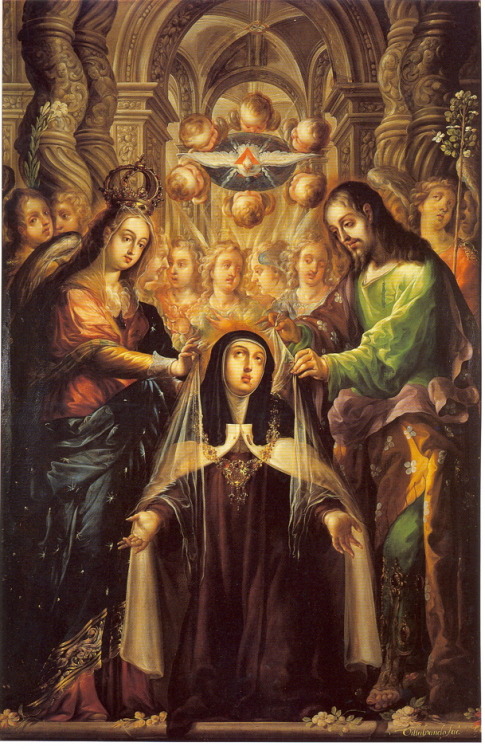
St. Teresa of Avila Receives the Veil and Necklace from the Virgin and St. Joseph by Cristóbal de Villalpando - 17th c


Wednesday, May 15, 2013

The Presence of God

JMJT! Praise be Jesus Christ! Now and Forever!


THE PRACTICE OF THE PRESENCE OF GOD


“Let us commit ourselves entirely to Him, and banish everything else from our hearts and minds. He wants to be alone there, so we should ask him for this grace. If we do what we can, we will soon see the change we hope for in ourselves.”  


Dear Ones-

Many of us were together for the Day of Recollection last weekend where we learned different methods of meditation and practiced them.  One workshop focused on the Practice of the Presence of God. An overall thumbnail sketch of this method of praying without ceasing, and keeping Our Lord constantly present in one's heart was explored. The basics of this quest for realizing the perpetual presence of God in our hearts is based on 2 principles as outlined below:

1. Abandonment to God’s Will: (AAA)   
a. Abandon oneself to God in faith, hope, and love
b. Act in child-like trust & dependence
c. Accept our life circumstances and being in harmony with all of God’s creation:

2. Loving Mindfulness of God
a. Doing little things as they arise for love of God (The Little Way)
b. Cast out all that does not pertain to God (The way of Nada”)
c. Making an oratory of our hearts (The indwelling)

We know that remaining in the presence of God can be difficult amidst life's distractions. The question arises, how can we achieve this? One strategy used by Br. Lawrence can be summed up in the acronym CARMEL. Each letter stands for an important component of staying on God's presence and replacing our self-dialogue with constant communion with Him. 

CARMEL

Confess 
Admit sins
Renounce all else
Meditate on & Murmur arrow prayers prayers to God continuously throughout the day
Eventual contemplative prayer will be achieved
Love & Union with God will become perpetual – a divine union

Our Carmelite saints have a strong tradition of pondering the Lord in their hearts "day and night" in loving imitation of Our Lady.  I shared some of the ways in which this beautiful practice has uniquely manifested itself in so many of our Carmelite saints. This chart starts with our Blessed Mother on the bottom along with Elijah as our Carmelite foundation, and flows upward with the firm and prayerful example of St. Teresa of Avila and St. John of the Cross who reformed the order.  It is to illustrate the dialectic nature of this type of prayer, and how we are to use the basics as outlined by Brother Lawrence of the Resurrection, but accept and know that God also determines the individualized means by which to teach us to dwell perpetually with Him within the sanctuary of our hearts. 

Carmelite Foundational History of the Practice of the Presence of God
St. Edith Stein: Practice of Presence through uniting suffering to that of Crucified Christ in radical trust. “It is easier to have oneself nailed to the cross with Christ, than to become a stammering babe with him.”

Bl. Candida of the Eucharist: Practicing the presence through Eucharistic Adoration and then becoming a living host, or one who was united to Jesus in the Eucharist perpetually in all daily activities of prayer, recreation, and work.

St. Therese of Child Jesus: Little Way of love and child-like abandonment. "Miss no single opportunity of making some small sacrifice, here by a smiling look, there by a kindly word, always doing the smallest right and doing it all for love.” May you be confident, knowing you are a child of God. Let this presence settle into your bones and allow your soul the freedom to sing, dance, praise and love. It is there for each and every one of us.


Bl. Elizabeth of the Trinity: Indwelling of the Blessed Trinity thru words of St. Paul & life of BVM who drew Trinity within herself. Wrote, “May the God who is all love be your unchanging dwelling place, your cell, & your cloister in the midst of the world. Remember that He dwells in the deepest center of your soul as if in a sanctuary where He wants always to be loved to the point of adoration.” She sought to “identify my soul with every movement of your soul.” Her mission: “In heaven, I believe my mission will be that of drawing souls into int. recollection, helping them go out of themselves, to cling to God through a movement which is wholly simple & wholly loving; and to preserve them in that great silence of the ‘within’, which allows God to imprint Himself on them & to transform them into Himself. 
Brother Lawrence of the Resurrection: Practicing the Presence of God based on 2 pillars: Abandonment of self-will to God & loving mindfulness.
To accomplish this we must cooperate, persist, and persevere in faithfulness. “Let us commit ourselves to him, and banish everything else from our hearts and minds. He wants to be alone there, so we should ask him for this grace. If we do what we can, we will soon see the change we hope for in ourselves.”  AND “We must never tire of doing little things for the love of God who considers not the magnitude of the work, but the love. In the beginning, we must not be surprised if we often fail, in the end, once the habit is formed, we will be able to act without thinking about it and with great delight.” AND “I know that to do this your heart must be empty of all other things b/c God desires to possess it exclusively, and he cannot possess us exclusively without first emptying it of everything other than himself.”
St. Teresa of Avila: Stressed humanity of Christ. Focus on Him in discursive meditation/mental prayer, which leads to prayer of quiet/recollection and eventually union. Saw prayer as ‘being on terms of friendship with God frequently conversing in secret with him who, we know, loves us.’ (Life 8:5) Describes presence of God within while representing Christ within herself. “We need no wings to go in search of Him, but only have to look upon Him within us.”
St. John of the Cross: Practice through ‘nada’ path. Remove all things that are not God in order to be united with God. Die to world and self. Die to all sensory and spiritual goods in order to realize union. “My soul is now divested, detached, alone & withdrawn from all created things, both from above and..below; & it has entered so deeply into interior recollection with you that none of them can discern the intimate delight I now possess in You.. Since my soul stays so far from them and abides in such profound delight with you   

BVM: “pondered all things in her heart.” Drew the Holy Trinity to herself at the Incarnation. Fruit of her womb: Emmanuel: God is with us

Elijah: the prophetical tradition of Carmel and is an inspiration to live in the presence of God, seeking Him in solitude and silence with zeal for God’s glory. (OCDS Const. I:5)


One of our members took this beautiful picture in the Sanctuary of the Church that revealed the presence of Our Lord.  


He is everywhere, and most especially in the Eucharist. This is the pinnacle of our faith and our starting point. We nurture his Eucharistic presence in our hearts, whether we receive Our Lord daily or each Sunday. Enjoy this inspirational video that speaks so beautifully of this reality. From the strength He imparts within, we ask the Holy Spirit to create a perpetual dwelling place for Him to reside. Amen.


Wednesday, May 8, 2013

Fr. Doug Lorig's Homily on The Carmelite Way

JMJT! Praise be Jesus Christ! Now and Forever!

Dear Ones-

I hope that you enjoy this special homily Fr. Doug gave on 'The Carmelite Way'  that we are all  embracing, and which he spoke about as we joined together to celebrate promises and vows within our community last month. Enjoy another beautiful teaching from our beloved spiritual assistant!

Sunday, April 21, 2013

The Carmelite Order & Our Recent Popes

JMJT! Praise be Jesus Christ! Now and Forever!

On this Good Shepherd Sunday, I thought you might enjoy a recap of the love and unified prayer that our order has shared with Our Holy Fathers as well as our priests.  This providential picture of our three most recent popes together below is truly a gem! 


Here is the letter that our OCD Father General sent to Pope Francis last month following his election.

Letter from Fr General to Pope Francis
P. SAVERIO CANNISTRÀ-Roma-Italy (14-03-2013).- Holy Father,Our family of Discalced Carmelite friars, nuns, and seculars bids you the warmest welcome. With the simplicity our fathers and mothers in Carmel have handed down to us, we open the doors of our hearts to you. Count on us, Your Holiness; on us, your sons and daughters in Christ Jesus.
Our Holy Mother Teresa taught us to live the gift of faith in a communion of love with the Church, in the spirit of obedience to the Vicar of Christ, placing our lives at the service of the Kingdom. This we have done with your predecessors and this we will do with you.

Keeping in our hearts a profound gratitude towards your predecessor, Benedict XVI, whose life has helped us so much to set our eyes on Christ, we have lived with trusting serenity, expectant prayer, and elated joy the election of a new Pope. Every day we told the Lord: “Show us who you have elected to guide the barque of Peter in this time of grace.” Now that we have seen you, we welcome in Your Holiness he whom God has sent to us.
Our heartfelt thanks for having said yes. We imagine it was not easy to do, faced with the arduous tasks awaiting you. But we have seen in your countenance the true humility of he who offers himself as an instrument of the Lord, who allows Him to work through his words, his decisions, his actions. In Your Holiness we have once again recognized the work of the Spirit, his renewing strength, which contains continual surprises for his faithful, and for that we give thanks to God. 

 Holy Father, we want to tell you with a bit of daring that we want to be your friends. We want our family of Carmel to be like a new Bethany for Your Holiness,
where you can rest from your labors and where, together, we can talk about what we most love: our Friend Jesus Christ, his Church, the poorest of our times. The name you have chosen encourages us to do so: the name of who, following the footprints of Christ, has always wanted to be the smallest among his brothers.
We will be missionaries with you when you undertake the journey to announce the Gospel to the whole world. We will join Your Holiness when you proclaim with courage and strength the peace and justice of the Kingdom of God. When the cross appears, you will have us beside you to embrace it with you. And we will also be at your side when you retire in prayer to speak to the Heart of Jesus.

We place your pontificate under the protection of Mary, who for us is the “Flower of Carmel, fruitful Vine, Splendor of Heaven, Virgin Mother, Mother most tender, Star of the Sea.”
 

May God bless you!
 

Your sons and daughters of the Discalced Carmel.
Source: http://www.carmelitaniscalzi.com


Just recently Pope Benedict took time out of his busy travelling schedule to visit with OCD sisters in Lebanon:

Mary Magdalene, the "apostle to the apostles", a meditation for ...
Pope Benedict visits Carmelites at Harrisa Lebanon

Pope Benedict XVI with Carmelites in Lebanon
Harissa - Lebanon (16-09-2012).- Pope Benedict XVI visited the Lebanese Discalced Carmelite Monastery of the Theotokos and of Unity.

The Holy Father wished to greet the community of Discalced Carmelite Nuns in Harissa before concluding his apostolic trip to Lebanon, which took place September 14 through 16.

During the brief, 10-minute visit, the Pope gave his apostolic blessing to this contemplative community and encouraged it to continue its service to the Church and to society.


Pope Benedict also chose an OCD priest to lead the Lenten Spiritual Exercises just two years ago.  See  LETTER OF HIS HOLINESS BENEDICT XVI 
TO Fr. FRANÇOIS-MARIE LETHEL, O.C.D.,
PREACHER OF THE LENTEN SPIRITUAL EXERCISES See
http://www.vatican.va/holy_father/benedict_xvi/letters/2011/documents/hf_ben-xvi_let_20110319_lethel_en.html


Sunday, March 17, 2013

St.Patrick's Devotion to Elijah

JMJT! Praise be Jesus Christ! Now and Forever!
I bow before the Father who made me
I bow before the Son who saved me
I bow before the Spirit who guides me
In love and adoration
I give my lips
I give my heart
I give my mind
I give my strength
I bow and adore Thee
Sacred Three
The Ever One
The Trinity 

Happy St. Patrick's Day!  I thought I would share some of the Carmelite connections that exist between Ireland and the Carmelite order, as well as St. Patrick himself!  According to the book written by Fr. James P. Rushe (1903) in the historical account Carmel in Ireland: a narrative of the Irish province of Teresian, or Discalced Carmelites: 1625-1896... the Carmelite order is highly intertwined with the history of Christianity in Ireland. In his first chapter, Fr. Rushe shared the following:

"Carmel in Ireland is a book about the foundations of Carmel after the Rule was established and the order had to leave the Holy Land. It also chronicles the fact that St. Patrick’s precursor, St. Palladius was in fact a Carmelite of the Ancient observance.  He came form St. Anne’s Monastery near Jerusalem and living with the Carnelite Monks. He had been some years at St. Anne’s, advancing rapidly in the way of Perfection, when he felt himself inspired to labor for the salvation of souls: this zeal was the fruit of his precious life of prayer. Submitting the matter to the holy Religious, Palladius was advised to consult with the Sovereign Pontiff himself, and abide by his decision. St. Celestine received the Monk’s proposal with warm approbation; and after some time, consecrated him bishop, and sent him, together with the other Carmelites from St. Anne’s, to preach the Gospel in the Western Isles.  They reached Ireland about the year 431, having endured many hardships in their long and perilous journey. The Irish people readily understood the object of the strangers visit as they had already heard of the Christian religion. Many conversations were made and even a few churches were built. But soon the Pagan priests became jealous of St. Palladius and his companions and finally succeeded in having him driven from Ireland. However, a number of his disciples still remained here, although they had to hide themselves from the persecution raised against them by the powerful Druids. St. Palladius, with some others, found a refuge among Christians of Scotland and there he died around 432 AD.

Under the direction of the fugitive Carmelite monks, the practice of asceticism was inaugurated among the faithful or Ireland using the method observed by Carmelites in the East. In the Life of St. Patrick, before his coming to evangelize the Irish nation, there were Christians who had already arrived at an eminent degree of sanctity. He himself had a particular devotion to Elijah. In His Confessions allusion is made to one occasion specifically when he had recourse to St. Elijah who at once came to his Assistance and consoled him after he had been most violently assaulted by Satan." (See http://books.google.com/books?id=WC_KbSuqjfIC&printsec=frontcover&source=gbs_ge_summary_r&cad=0#v=onepage&q&f=false)
Another book entitled "The History of the Scottish Nation" chapter 16  by James A. Wylie , gives an account of St. Patrick's encounter with the religion of the Druids. The occasion was the annual Festival of Tara, also known as Baal's Fire. "And Elijah came unto all the people, and said, How long halt ye between two opinions? if the LORD be God, follow Him: but if Baal, then follow him. And the people answered him not a word" (1Kings 18:21).  (See http://books.google.com/books?id=-10JAAAAIAAJ&printsec=frontcover&source=gbs_ge_summary_r&cad=0#v=onepage&q&f=false)
As mentioned above, St. Patrick had a great devotion to Elijah and recounts in his Confessions a dream where he calls on the great prophet for protection.  He calls it the Stone Dream. It happened like this: Samael [Son of the Blind] came to Saint Patrick at night after the sailors had dined on the pigs. “He fell right over me, like a huge rock, so that none of my limbs had any strength left in them ” Saint Patrick called for the Prophet Elijah to save him. ..“And suddenly, the splendor of that sun flooded over me, and at once I was rid of my powerlessness.” (20, 37, C)

St. Patrick remains a figure in that is remembered by many secular and religious people alike, as well as the Irish and non-Irish. He is seemingly a saint for all people, perhaps due to the larger than life legends and stories that are associated with the conversion of Ireland. If one looks more closely, one sees that the soil of Ireland was made fertile by the first Carmelite missionaries who arrived there with St. Palladius, and that the conversion was dramatically realized through the warrior prayers, zeal, and perseverance of St. Patrick who in many ways emulated our dear Elijah. We are called to carry that missionary zeal with us wherever we go, that we may imitate the holiness and humility of St. Palladius and St. Patrick as we cooperate with God's gifts and touch others' lives and hearts.   
Before we go out each day, let us ask God to place this zeal for His Glory upon our hearts and minds, our lips, and eyes as St. Patrick did on his breastplate. Let us be sure to dedicate the day and all that it holds for us to Him.
I weave a silence on my lips
I weave a silence into my mind
I weave a silence within my heart
I close my ears to distractions
I close my eyes to attractions
I close my heart to temptations
Calm me Lord, as you stilled the storm
Still me O Lord, keep me from harm
Let all the tumult within me cease
Enfold me Lord in your peace. Amen.